
Lesson 2.4 · Tier 2 — First Build
Your first digital product will not come from a brilliant new idea — it’ll come from something you already know and have stopped noticing you know. That’s the whole trick, and it’s why most people never make one: they wait for an idea worthy of selling while walking past a dozen things they do on autopilot that someone else would pay to skip learning. Mini-Build C is packaging one of those into a template, a mini-guide, or a prompt pack — polished enough that a stranger could pick it up and use it without you in the room.
This is the build that turns you from a consumer of AI into someone who ships assets. A web page is a thing that exists; a media file does a job; but a digital product is the first thing you make that works for other people while you sleep. That’s a different category, and Tier 2 wants you to taste it once.
Your first digital product starts with what you already know
The hard part isn’t building — AI handles that in an afternoon. The hard part is spotting the raw material, because it’s invisible to you precisely because you know it. Three places to dig:
The thing you do the same way every time. A process you’ve repeated so often it feels like nothing — meal-prepping, onboarding a client, planning a trip. Repetition is the sign it can become a template.
The question people keep asking you. Whatever friends come to you for is a mini-guide with a built-in audience — you’ve just been delivering it one conversation at a time.
The prompts that already work for you. Your Tier 1 prompt library is raw product — cleaned up, explained, and organized, a prompt pack is the most native first digital product an AI builder can ship.
Then build it with the cockpit: describe what you know, have the AI draft the structure, and — the step that makes it a product and not a note to self — apply the finishing discipline from Lesson 2.3. A digital product is finished when a stranger can use it with zero access to your head: clear title, an intro that says who it’s for, steps that assume nothing, an example.
And there’s a test for that, cheaper than any feedback survey: the cold test. Hand the thing to one person with zero explanation — no “so basically what this is…”, no walkthrough, just the file. Then watch (or ask) where they stalled first. The first stall is never where you expect, because you unconsciously filled the gap with knowledge from your own head — the exact knowledge the product exists to replace. Fix that one stall, and only that one. A first product that survives one cold test is more finished than most things people sell.
One scope rule to keep this honest: this build’s job is to ship, not to sell. Pricing, audiences, landing pages, distribution — that’s an entire craft, and it lives in the Business track waiting after this tier. Trying to learn “make a product” and “sell a product” in the same week is how beginners end up doing neither. Today the win condition is simpler and rarer than revenue: a finished thing a stranger can use, existing in shareable form.
From the build log: the product hiding inside this site
Here’s a digital product that already exists, and you’re reading its output right now. Every lesson on this site is built from the same repeatable system: a fixed template at the top of each file — publish instructions, an SEO package (focus keyword, title, meta description), a screenshot list — followed by the same structural skeleton (a reproducible experiment, a “from the build log” receipt, a “do this today”). That system wasn’t bought or downloaded. It emerged from doing the thing repeatedly, then getting captured into a reusable shape so every new lesson starts from it instead of from blank.
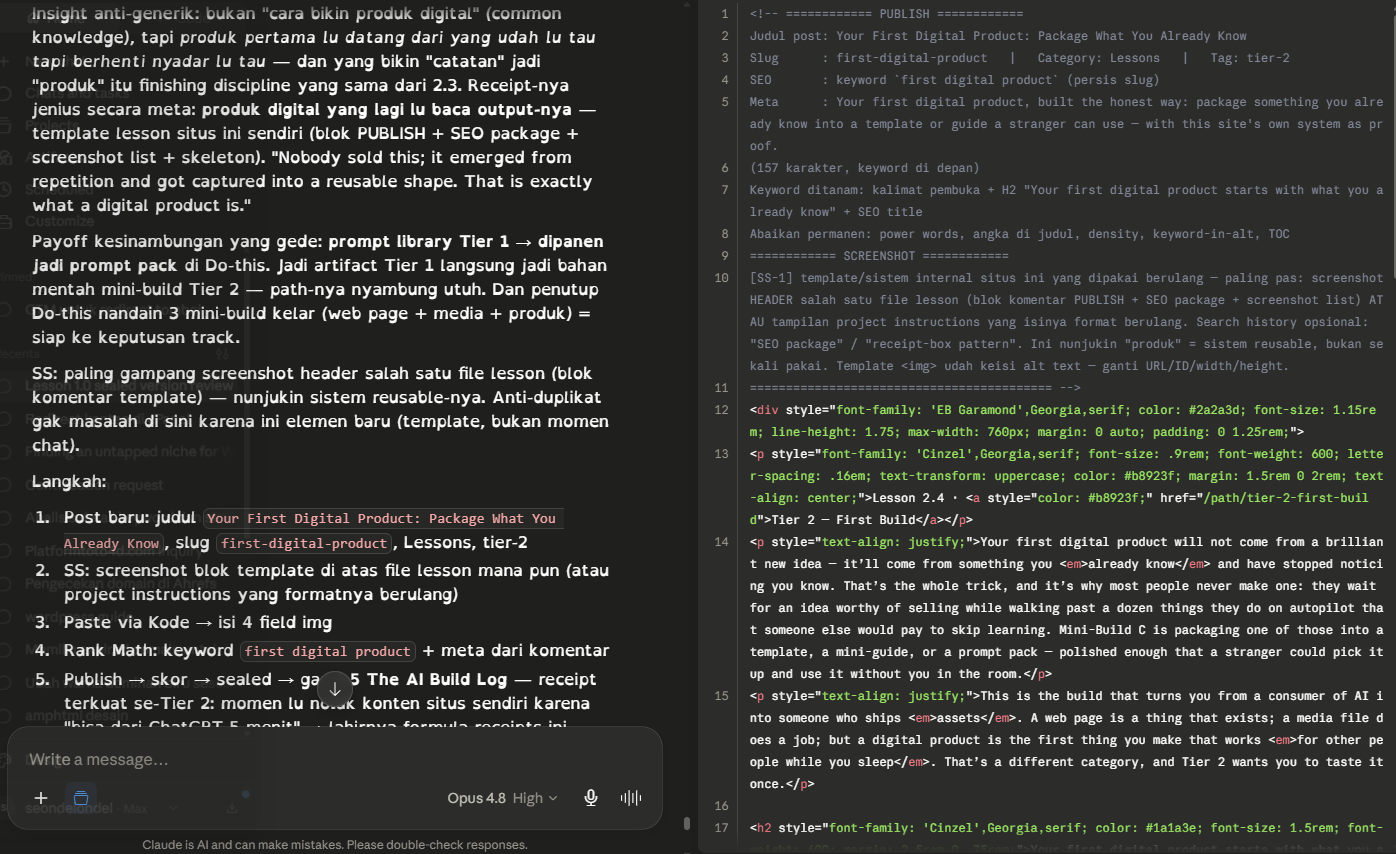
From the build log: the repeatable template every lesson on this site is built from — publish rules, SEO package, screenshot checklist. Nobody sold this; it emerged from repetition and got captured into a reusable shape. That is exactly what a digital product is.
Notice what that template is: knowledge that was learned once, then frozen into a form that a stranger — or a future version of the same builder — could pick up and run without re-deriving it. That’s the definition of the thing you’re about to make, and the proof it comes from repetition, not inspiration. You are already sitting on at least one system like this. The question isn’t whether you have raw material for a first digital product — it’s which of the things you already do on autopilot you’re going to stop taking for granted and package first.
Package one thing you already know into a finished digital product a stranger could use. Fastest path: take your Tier 1 prompt library, have the cockpit help you clean it into a titled, explained “prompt pack” — who it’s for, when to use each one, one example each. Export it as a shareable file, then run one cold test: send it to one person with zero explanation and fix the first place they stall. That’s your third mini-build done — and with the web page and the media piece, you’ve now shipped in all three specializations.
Next: the habit that turns three builds into proof — and one day, your tale.Lesson 2.5 — Document Everything →