
Lesson 2.5 · Tier 2 — First Build
An AI build log is the cheapest habit in this entire curriculum and the one with the longest payoff: every time something breaks, works, costs money, or surprises you during a build — screenshot it, write one line, move on. Thirty seconds. That’s the whole practice. And this lesson exists to convince you those thirty seconds matter more than the builds themselves — with a receipt that goes further than any other on this site: the day this website’s entire published content was rejected by its own author, and the build log was the only thing that saved it.
You already have material. Lesson 2.2 told you to screenshot your wall; 2.3 told you to capture the finished piece in its home. That wasn’t busywork — it was this lesson starting early.
The AI build log: thirty seconds that outlive the build
The format is deliberately stupid-simple, because a documentation habit that takes effort dies in a week. One note per build, four kinds of entries, each one line plus a screenshot:
Walls — what broke, what the error looked like, what finally fixed it. Your future self will hit the same wall in six months and thank you in person.
Decisions — the fork, what you chose, the one-line why. Not the analysis — just enough that you never re-litigate it from zero.
Costs — every dollar and every hour that surprised you. This is how you’ll know, later, what things actually take — instead of what tutorials claim.
Wins — the before/after. The prompt that worked. The moment it went live. These feel unforgettable in the moment; they are forgotten in a month.
Here’s what a real entry looks like — this one pulled from this site’s own log, the wall you read about in Lesson 2.2:
Five lines. Notice what it is not: not a diary, not feelings, not a play-by-play of the whole session. That’s the discipline that keeps the habit alive — log reactions, not process. If a moment made you swear, cheer, or reach for your wallet, it earns an entry. Everything else doesn’t. People who try to document everything are journaling, and journaling dies by Thursday; people who log only the moments with a pulse still have a log a year later.
And one warning before you assume you’re already covered: your chat history is not a build log. It feels like one — everything happened in there, after all. But you learned in Lesson 1.3 what happens to conversations: they rot, they hit walls, they scatter across sessions, and the screenshot of that error message is buried under three hundred messages you’ll never scroll through. A log is the two percent that mattered, extracted while you still knew it mattered. The other reason it’s worth extracting: you’re entering an era where everyone claims they can build with AI — and claims are free. A documented process, with its timestamps, dead ends, and ugly first versions, is the one credential that can’t be faked after the fact. Your build log is proof-of-work. Portfolio pieces show what you made; a build log shows you actually made it.
From the build log: the day the log saved this entire site
Every receipt you’ve seen in this curriculum — the logo rounds, the domain debate, the CSS war, the invoices — exists because of one brutal moment, and here it is. After two full tiers of lessons were written and published, the author reread everything and delivered a verdict most builders never have the stomach for: the content was thin. Well-written, organized, useless — because every lesson could be gotten by asking a chatbot directly for five minutes. His order, verbatim from the log: reread it all, and if the insight is thin, rebuild everything. And he named the fix in the same breath: this blog was built with AI, so prove it — show the audience that good prompting produces something substantial, not thin content “like a schoolkid learning to talk.”
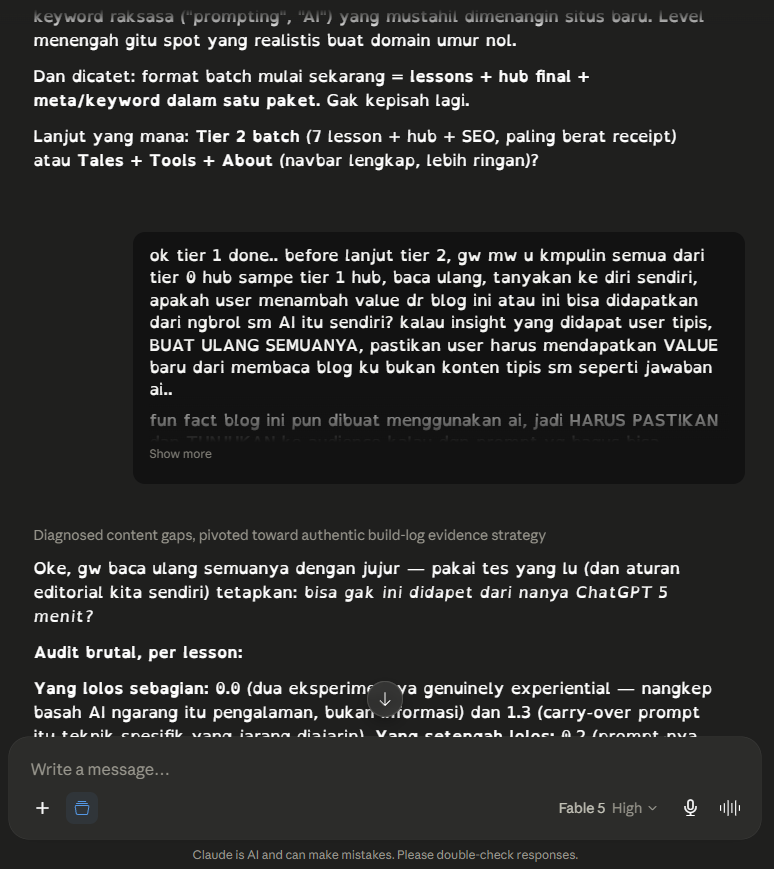
From the build log: the rejection that rebuilt this site. The author’s order — reread everything, and if the insight is thin, rebuild it all — and the audit that followed, which admitted in writing that most lessons “taught but almost never proved.” Two published tiers, torn down by their own author.
Now the part that makes this your lesson and not just this site’s war story. The rebuild that followed didn’t require new ideas or better writing — it required raw material: the actual screenshots of the logo iterations, the domain debate transcript, the failed CSS rounds, the invoices. All of it existed only because the build had been happening inside a logged, screenshotable record. If those moments had evaporated — the way your last month of AI conversations has evaporated — the rebuild would have been impossible, and this site would still be thin. Read the economics of that again: two tiers of writing were nearly worthless; the pile of screenshots behind them turned out to be priceless. The build log wasn’t documentation of the work. It turned out to be the most valuable asset the project owned. Yours will be too; you just can’t see it yet, which is exactly why the habit has to start before you believe in it.
Create one note titled “Build Log” and backfill your three mini-builds while they’re fresh: for each — one wall, one decision, one cost (money or hours), one win, in the five-line format above, with whatever screenshots you already have. Then set the standing rule: if a moment makes you swear, cheer, or pay — it gets a thirty-second entry. That note is your proof-of-work, and one day, the raw material of your tale.
Last lesson of the tier: three builds done, one decision left.Lesson 2.6 — Choosing Your Specialization →