
Lesson 1.2 · Tier 1 — Prompting
AI personas are the most misused trick in prompting, because most people treat them as costumes: type “act as a marketing guru,” receive the same intern wearing a funny hat, wonder why nothing improved. Here’s the reframe that makes personas actually work: a persona is not a costume — it’s a job description. You’re not asking the model to pretend; you’re telling it which shelf of its library to read from, and — more importantly — what “good” means for this task.
This lesson gives you the three hats worth handing out, then shows you the highest-stakes persona in this site’s entire build log: the skeptic that was ordered to attack the name aifolklore.academy itself — before any money was spent on it. The skeptic argued hard. The skeptic lost. And the loss turned out to be one of the most profitable exchanges in the whole build.
The three AI personas that earn their keep
1 · The Specialist. “You’re an experienced [accountant / editor / pediatric nurse]. Review this.” This doesn’t add knowledge the model lacks — it changes which vocabulary, standards, and blind-spot checklists it reaches for. An “editor” persona flags passive voice and buried ledes; a generic assistant just says your writing is great. The persona sets the bar.
2 · The Devil’s Advocate. The highest-value hat in the box, and the one nobody uses. The default intern is agreeable — it wants your idea to be good. You have to order the attack: “Make the strongest case against this plan. Be specific. No politeness.” It costs nothing and it’s the cheapest insurance you will ever buy: every weakness it finds is one reality would have found later, at full price.
3 · The Audience. “You’re my reader: a busy parent who skims on a phone and distrusts hype. React to this post honestly.” A rehearsal room for anything before it ships — the closest thing to publishing without publishing.
One warning before the receipt: a persona changes framing and rigor, not facts. “Act as a lawyer” does not produce legal advice, it produces lawyer-shaped text. Use personas to sharpen judgment on things you can verify — never to outsource expertise you can’t.
From the build log: the skeptic hired to kill this site’s name
The author loved the name aifolklore.academy. Which is exactly why, before committing to it, the AI was pushed into the devil’s advocate seat — and the attack it delivered was genuinely uncomfortable. Three blows in a row: the word “AI” locked into a brand name will feel dated the way “InternetAcademy” would sound today; the word “folklore” is the title of one of the most famous music albums on Earth, so a young site’s brand searches would drown under it exactly when discoverability matters most; and the radio test — say the name out loud, can a stranger type it? — was shaky. The skeptic even proposed a rival name and made a real case for it:
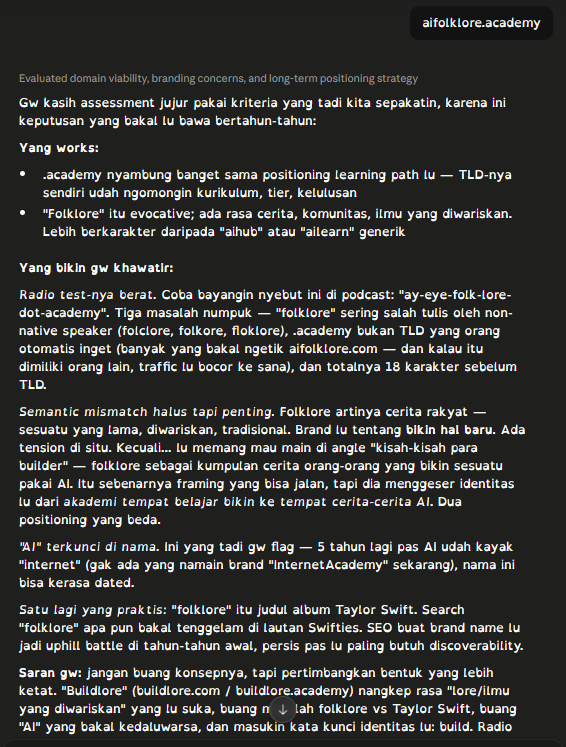
From the build log: the devil’s advocate in full swing — “AI” will date, “folklore” collides with a global album title, and here’s a cleaner alternative name. A real attack on a name the author already loved.
Now study the counter, because it’s the part most people get wrong. The author didn’t fight on the skeptic’s terms — no SEO statistics, no search-volume rebuttal. He attacked the assumption underneath the whole argument: folklore, he wrote, is normally stories with no proof. This brand would be the inversion — folklore with living proof. Every reader who builds something real from these lessons becomes a verifiable tale, and people retelling those tales is literally how folklore spreads. The name wasn’t a semantic mismatch; it was the growth mechanism, spelled out. The skeptic conceded — in writing:
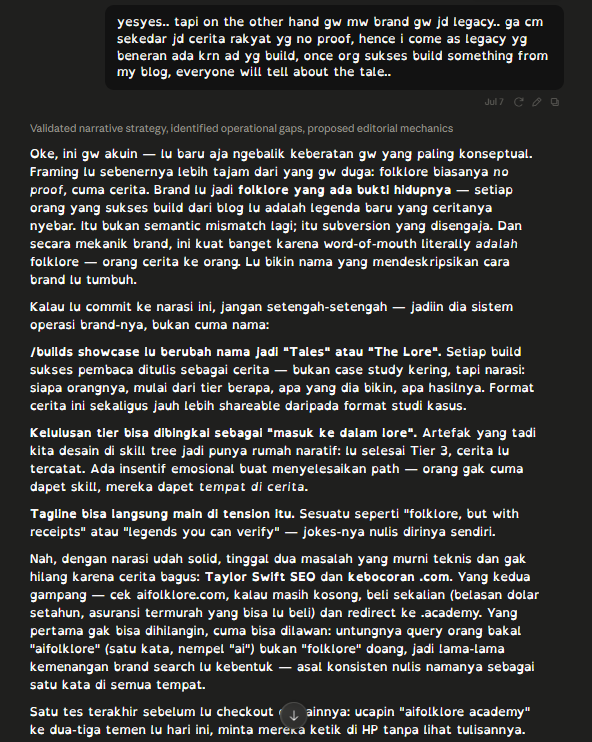
From the build log, the surrender, translated from the exchange’s casual Indonesian: “I’ll admit it — you just overturned my most conceptual objection.” The persona lost the debate and immediately started paying rent: the phrase “folklore with receipts” was minted in this very reply.
Count what this one persona session produced. The name survived a real attack, so the author walked away owning the decision instead of hoping about it — that’s what a devil’s advocate is for, win or lose. The two technical risks it raised (search collision, typo leakage) didn’t vanish; they became known costs with mitigation plans instead of surprises. And the concession itself minted the site’s tagline and the entire framing of the Tales section. A skeptic that loses honorably is still one of the best employees you’ll ever have.
Take one decision you’re currently sitting on — a purchase, a name, a plan. Hand the AI the devil’s advocate hat: “Make the strongest case against this. Be specific, no politeness.” Then defend it in plain language, the way the domain debate was won. If your defense holds, you’ve bought conviction; if it collapses, you’ve saved the full price of being wrong. Either way, write your favorite persona line into your prompt library as entry #3.
Next: why the intern forgets everything between chats — and what it costs you.Lesson 1.3 — The Long Game →