
Lesson 1.1 · Tier 1 — Prompting
Here’s the habit that separates Tier 1 graduates from everyone else, and it isn’t a clever prompt: they never accept the first answer for anything that matters. Not because first answers are bad — because first answers are averages. The model’s opening move is always the safest guess at what someone like you probably wants. The good stuff lives one or two pushes deeper, and pushing costs ten seconds.
This lesson teaches prompt iteration as four concrete moves — and then shows you all four at work in the wild: the five real rounds it took to get from “an open book with a spark” to the golden lady in this site’s logo. Including the round where the author’s feedback was, verbatim, “ugly.”
The four pushes of prompt iteration
1 · Narrow. First answers spread wide to hedge their bets. Point at the good part: “Drop everything except point 3 — expand that into the full answer.” Broad first, narrow second is often faster than trying to write the perfectly narrow prompt upfront.
2 · Redirect. When the direction is wrong, say so bluntly — the intern has no feelings to spare: “Wrong direction — I don’t want to apologize, I want to firmly restate the deadline. Rewrite.” One honest sentence outperforms starting a new chat and hoping.
3 · Critique. The counterintuitive gem: make it attack its own work. “What are the three weakest parts of what you just wrote? Now rewrite fixing them.” The model is genuinely better at spotting flaws than avoiding them on the first pass — the same engine, pointed backward, becomes an editor.
4 · Variants. When you can’t articulate what’s off, stop describing and start choosing: “Give me three versions: one warmer, one shorter, one bolder.” Taste is easier than specification — you’ll recognize the right one instantly.
From the build log: five rounds of prompt iteration
Now watch all four pushes carry a real project. The logo brief started simple: a flat vector of an open book with a golden spark. Five rounds later it was a photorealistic genie summoning 3D golden letters. No round was wasted, and no round was the plan — that’s the point.
Round 1 → 2, variants + narrow: four book-and-spark concepts generated; one chosen, with instructions to grow — a holographic projection of the site’s name rising from the pages. Round 2 → 3, redirect: the hologram text was unreadable; feedback demanded solid 3D letters and added a new idea mid-flight — a feminine figure emerging from the book, “like a mother of AI legends.” Iteration isn’t just fixing; it’s where better ideas surface. Round 3 → 4, the blunt redirect: the style came back as illustration, not photography. The feedback, translated from the author’s Indonesian: “the result looks like this — not a real person, ugly.” Brutal, three seconds to type, and it worked — the next round pivoted to photorealistic with a structured prompt (you saw that receipt in Lesson 1.0). Round 4 → 5, the precise redirect: the face under the hood was rendering as a black void. The fix below is the single best iteration example in the whole build log:
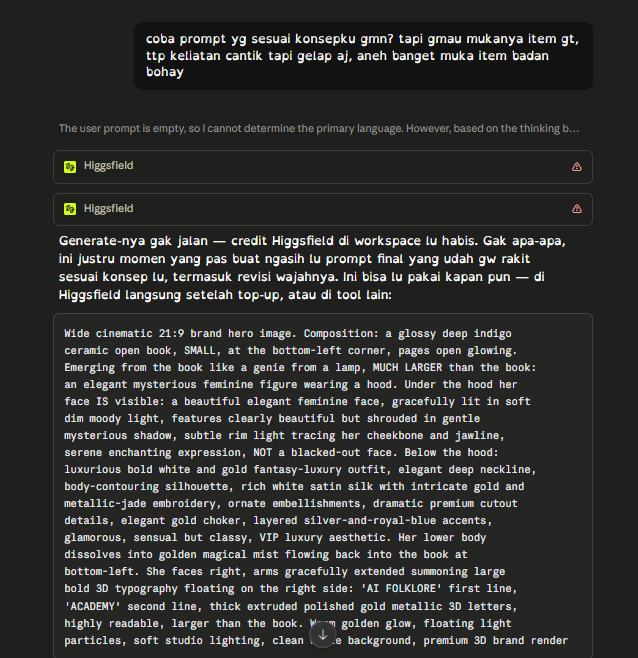 From the build log, round 4’s redirect in the author’s own words: “I don’t want the face blacked out — still beautiful, just darker. A black face on a glamorous body is bizarre.” The machine translated taste into technique: “face IS visible… lit in soft dim moody light… rim light tracing her cheekbone… NOT a blacked-out face.”
Study that exchange, because it’s the entire skill in miniature. The author didn’t know the lighting vocabulary — didn’t need to. He described what felt wrong in plain language (“beautiful but dark, not a blacked-out face”), and the machine converted feeling into specification: rim light, cheekbone, moody dim. Your job in iteration is honesty, not expertise. Name what’s wrong the way you’d tell a friend; let the intern find the technical words.
The rule of thumb to carry: if it’s leaving your hands — an email, a post, a logo, anything with your name on it — it gets minimum two pushes. If it’s just for your understanding, draft one is usually fine. And notice what five rounds cost here: a few minutes of typing feedback, total. The logo a design agency would have billed weeks for was iterated over one evening — because someone was willing to keep saying “not yet.”
Find a mediocre answer sitting in your chat history. Apply two of the four pushes — and push in plain language, the way the logo feedback did. Then add your favorite push, written as a reusable sentence, to your prompt library as entry #2. (The critique move is most people’s keeper.)
Next: the same intern, wearing three different hats.Lesson 1.2 — Personas →