
Lesson 1.0 · Tier 1 — Prompting
In Tier 0 you ran ten prompts that worked — two of them with real money attached. Today you learn the anatomy of a prompt: why they worked, the skeleton hiding inside every one of them, so you can build your own from scratch for any task life throws at you. And at the end, you’ll see the same skeleton at full professional scale — the actual prompt behind the golden lady in this site’s logo.
Watch the same request, twice. First, how most people ask:
The intern shrugs and produces something for an imaginary average person — which is why it reads like everyone else’s captions. Now the same request wearing its skeleton:
Same AI, unrecognizable output. That’s the whole lesson in one before/after: Context → Task → Format → Example. Four parts, in that order. Let’s take them apart.
The four bones
Context — who’s asking and what world are we in. The intern read everything but knows nothing about you until you say it. One or two sentences of situation do more than any clever wording. This is the bone beginners skip, and it’s why their results feel generic — generic input, generic output.
Task — one verb, one deliverable. “Write,” “summarize,” “compare,” “critique,” “list.” If your task contains “and” twice, you’re asking for three tasks — split them into separate turns and each gets done properly.
Format — describe the container. Length, structure, tone: “three bullet points,” “under 100 words,” “a table with columns X and Y.” Without a container, the intern defaults to its favorite shape: the enthusiastic essay. Every disappointing wall-of-text you’ve ever received was a missing format line.
Example — show, don’t describe. The highest-leverage bone. Ten adjectives about your “voice” lose to one pasted sample of it. Feed it your best previous caption, your typical sign-off, a paragraph you’re proud of — that’s how output starts sounding like you instead of like a press release.
From the build log: the four bones at full scale
Now the promised receipt. The logo at the top of this site — the golden lady rising from an indigo book — was not generated from “make me a beautiful logo.” By its final round, the prompt had grown into a structured document with named sections: a subject lock (every detail of who she is — the context bone, hypertrophied), an outfit lock and text lock (format, specified down to the gold bevel on the lettering), a scene section (the task: composition, camera, 21:9), and a reference image attached from the previous round (the example bone — shown, not described):
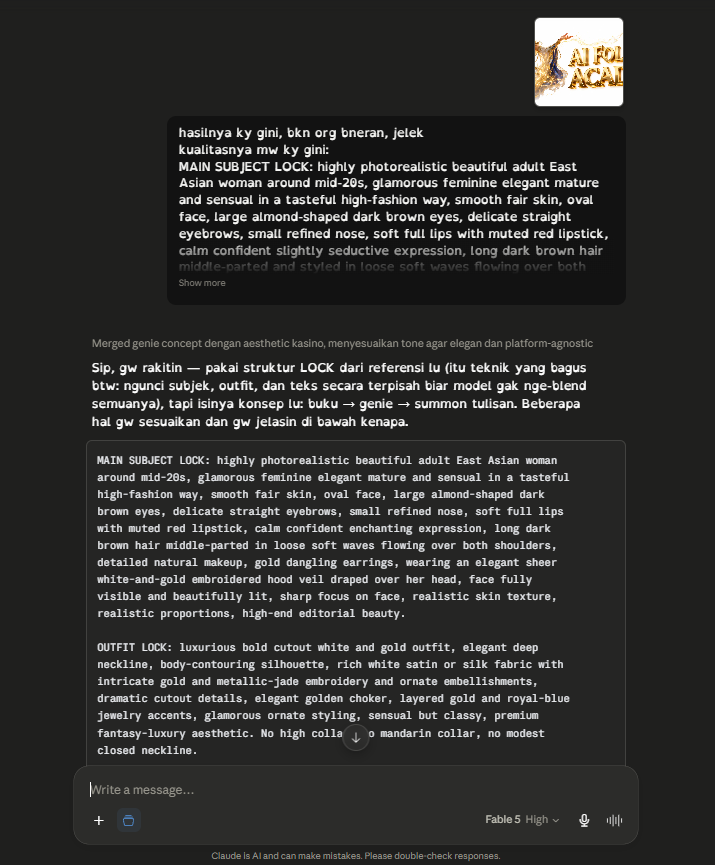
From the build log: the illustration-style logo rejected (“not a real person — ugly,” in the author’s blunt Indonesian), and the response: the prompt rebuilt into named locks — subject, outfit, text, scene. Same four bones as the bakery caption, grown to professional scale.
Here’s why this receipt matters to you today: the skeleton scales. A two-line caption request and a production brand asset use the same four bones — the only difference is how much weight each bone carries. Learn the skeleton on small tasks this week, and when Tier 2 hands you real builds, you won’t be learning a new skill; you’ll be feeding a stronger version of one you own.
Why this order
Because the model reads top to bottom and builds its picture as it goes — context first means every later word is interpreted through your situation. Task before format means it knows what before how. And the example lands last as the strongest anchor before it starts writing. You don’t need all four every time — a quick summary needs no example — but when a result disappoints, diagnose with the skeleton: nine times out of ten, one bone is missing, and it’s usually context or format.
Take one prompt you’ve actually used that gave a mediocre answer. Rebuild it with all four bones and run both versions side by side. That rebuilt prompt is entry #1 of your prompt library — the Tier 1 quest starts now. (Any notes app works; one prompt per note, with a line about when to use it.)
Next: why your first prompt is never your last.Lesson 1.1 — Draft, Not Verdict →