
Lesson 0.2 · Tier 0 — AI Basics
You have an account (Lesson 0.1). Now comes the moment most beginners stall: the empty chat box, a typed “hello,” a chirpy “hello! how can I help?” back — and the tab quietly closes. The cure is a starting repertoire of useful AI conversations, and the internet will happily sell you one: “500 ChatGPT prompts!” lists written by people who never ran them.
This list is different in one verifiable way: these prompts built things. Two of the ten come with receipts from this site’s own build log — you’ll see the actual conversations where they earned their keep, including the one that saved me $5,100. The other eight follow the same tested pattern. Run three today; that’s the assignment.
The ten useful AI conversations
1 · The dreaded email.
The brain-dump is the secret — the more mess you give it, the more you the result sounds. Never send draft one; say “warmer” or “shorter” once, then send.
2 · The document too long to read.
The second half is the trick — a plain summary hides the landmines; this prompt hunts them.
3 · The jargon translator.
Works on rental contracts, medical letters, terms of service. The “questions to ask” half turns understanding into leverage. (Facts that matter still get verified at the source — you know this from Lesson 0.0.)
4 · The decision you keep postponing — with receipt.
Don’t ask AI to decide — ask it to make both cases stronger than you could alone. Here’s this pattern earning $5,100 in this site’s build log: the domain I wanted was available as .com — for $5,100. Buy or skip? The answer opened with a verdict — skip it — then did the valuable part: broke down what a .com actually buys (typed-in traffic protection), why that matters less every year (people arrive via search and links now), and what the money would buy instead (a year of everything else).
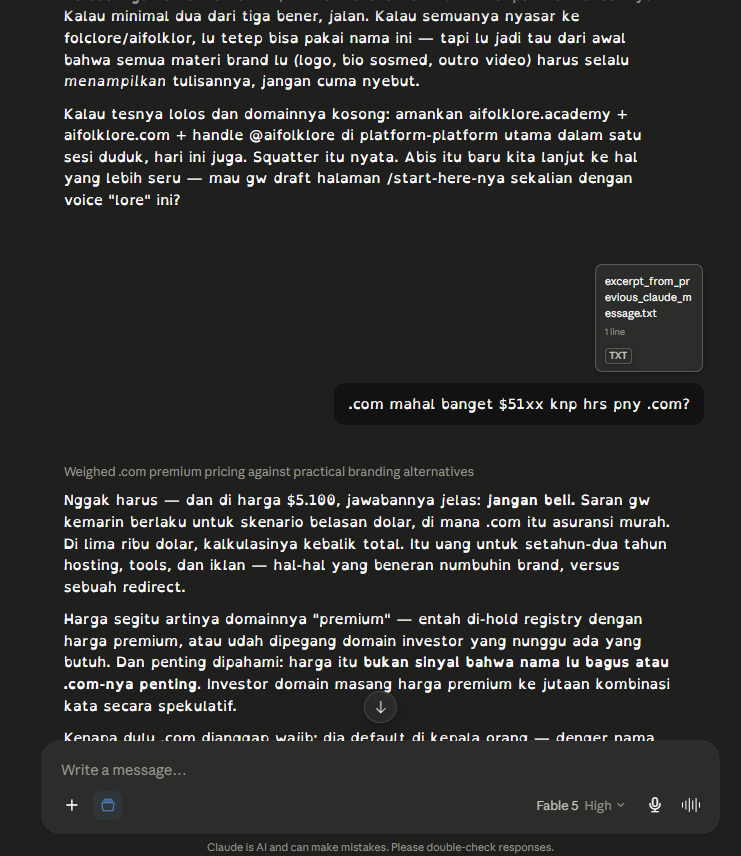
From the build log: the $5,100 question. The machine’s job wasn’t to decide — it was to make both sides of the decision visible. Total cost of the consultation: $0.
5 · The week planner.
“Realistic” and “slack for surprises” are the words that stop it producing a fantasy schedule for a robot.
6 · The trip (or event) skeleton.
Opening hours, prices, and schedules change — the structure is the value here; verify the bookable details.
7 · The patient tutor.
The quiz is what makes it stick — and answering wrong is free here, which is more than school offered.
8 · The tone shifter.
The daily workhorse — and quietly, the engine of this entire site: its author thinks in Indonesian, drafts flow between languages, and what you’re reading is the result. Anything crossing a language or formality border, this is the prompt.
9 · The meeting armor.
Ten minutes of this beats an hour of anxious rehearsing in the shower. The “one question to ask them” routinely steals the show.
10 · The idea machine — with receipt.
Twenty forces it past the obvious five; “no explanations” keeps it scannable. And this is how the name over this site’s door was found: a naming session that ranged from safe (BuildPath) to invented (Buildlore) to the strange one that stuck — because the wild end of the list is where names with a story live. The gold is rarely in ideas 1–7; it hides around 12–18.
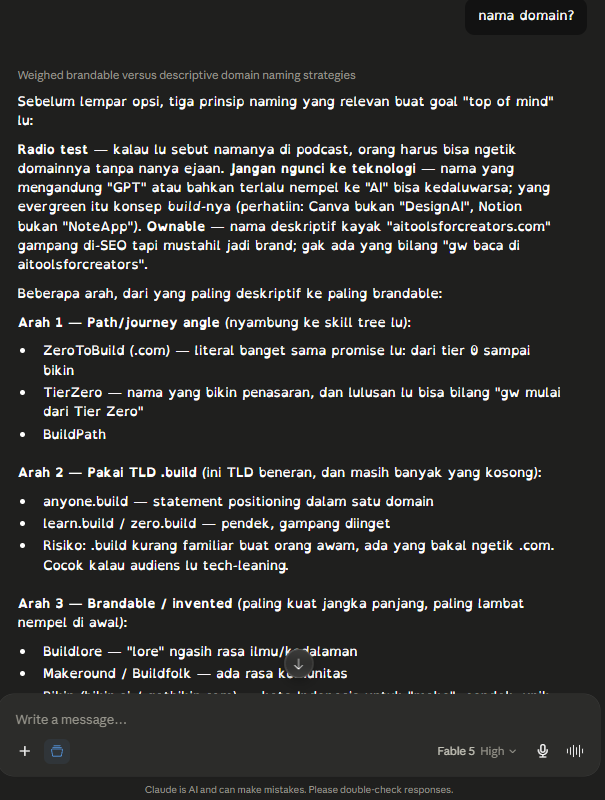
From the build log: the naming session. Somewhere between the safe ideas and the wild ones, “AI Folklore” was born.
What you just learned without noticing
Look back at the ten. Every single one gives context before asking, names the output it wants, and leaves room to iterate. That pattern — not any magic wording — is why they work, and why two of them could carry real decisions with real money attached. Making that pattern conscious and repeatable is the entire subject of Tier 1. You’re already doing it.
Pick the three prompts that made you think of a specific real task — and run all three before you close this tab. One of them is probably your Tier 0 quest in disguise. And per Lesson 0.0: screenshot the best result. Your build log is growing.
Next: the myths that fool everyone else — and the habit that makes you unfoolable.Lesson 0.3 — Myths vs. Reality →