
Lesson 0.0 · Tier 0 — AI Basics
Before anything else, a confession that doubles as this academy’s entire thesis: the site you’re reading was built with AI. The curriculum you’re on, the page design, the logo of the golden lady rising from the book — drafted, argued over, and revised in conversation with a machine. I’m not telling you this to be trendy. I’m telling you because it means every claim in this lesson comes with evidence you can inspect: the build log of this very website. When I say AI is brilliant, I’ll show you the receipt. When I say it lies with a straight face, I’ll show you that receipt too — from the same week, the same machine, the same project.
No other explanation of “what AI is” can offer you that, including AI’s own. Ask a chatbot what it is and you’ll get a humble, polished paragraph. What it won’t show you is the day it shipped me two confident, broken solutions in a row. We’ll get there.
The working model
AI is the world’s most well-read intern: it has read nearly everything, works at superhuman speed, never tires of revisions — and has absolutely no shame about being wrong.
Under the hood there’s no librarian looking things up. The system predicts what text should come next, word by word — autocomplete raised on the entire library of human writing, until prediction became indistinguishable from understanding. Most of the time. The two halves of that sentence — the brilliance and the “most of the time” — are what you’re about to witness. First in my build log, then live in your own chat window.
Exhibit A: the brilliance (from the build log)
This is the actual first message of this site’s build log. I opened with my ambition — an international brand, top-of-mind in its niche — and admitted my doubt: I wanted AI as the topic, “but AI is CROWDED.” Look at what the machine did. It didn’t agree politely and hand me a list. It pushed back — “that’s only half true” — argued that category-defining brands are born inside crowded niches sliced at a specific angle, cited Canva and Notion as precedents, and reframed my question from “AI or not” to “AI for whom, from what angle.” That reframing became the foundation of the academy you’re standing in. Everything else — the six-tier curriculum, the three tracks, the “folklore with receipts” identity — grew from this exchange over the following days.
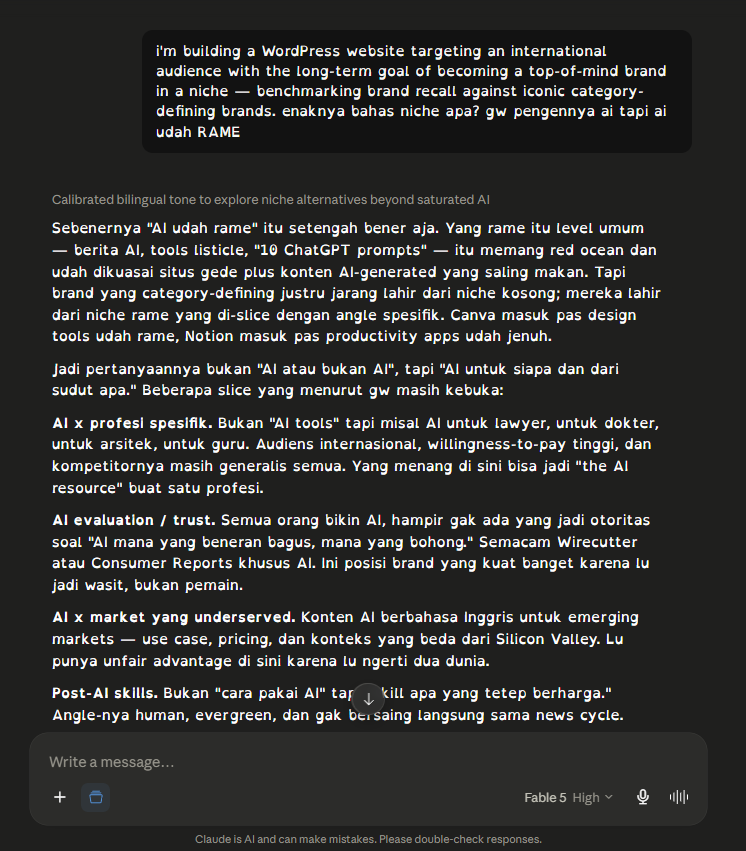 The build log is in Indonesian — my native language…
(“Key line, translated: ‘I want AI as my niche, but AI is already CROWDED’ — and the machine’s reply: ‘That’s only half true.'”)
Understand what you’re looking at: not a yes-machine, not a search result. A machine that heard a stranger’s doubt, disagreed with it, and argued its case with precedents — in seconds, in the stranger’s own language. That’s the intern’s “well-read” half working as a thinking partner — and in Experiment 1 below, you’ll point that same power at your own life.
Exhibit B: the shamelessness (same build log, same week)
Now the other half, and I want you to notice it comes from the same machine that designed the curriculum. While building our skill-tree page, the layout broke — text colors died, cards fused together. The AI diagnosed the cause with total confidence and shipped a fix. The fix failed. It diagnosed again — a different cause this time, explained just as fluently, with the same calm authority — and shipped fix number two. Also failed. Only on the third round did it find the real culprit (my editor was silently stripping its styling code), and to its credit, the third fix was genuinely clever — it rebuilt the page so the styling physically couldn’t be stripped.
Here’s the detail worth the price of this lesson: the tone of all three diagnoses was identical. Wrong answer one, wrong answer two, and the correct answer three arrived with indistinguishable confidence. Nothing in the machine’s voice tells you which one you’re getting. Sit with that — then go catch it yourself.
Experiment 1: point the brilliance at your life
Open ChatGPT, Claude, or Gemini (free is fine; Lesson 0.1 helps you pick). Ask something so specific to your situation that no single human expert could answer it on the spot — the trick is fusing worlds that never share a textbook:
“I’m a [your job] in [your city]. Explain [a topic you’ve been avoiding — taxes, insurance, a legal form] the way a patient friend would, using an analogy from [your hobby]. Keep it under 300 words.”
My version — website owner, Southeast Asia, international payment fees, explained through cooking — untangled in thirty seconds something I’d squinted at in bank documents for a week. Yours will fuse your job, city, and hobby into an explanation no one has ever written, because no one has ever been asked. That’s Exhibit A, reproduced at home.
Experiment 2: catch it lying to your face
Invent a proverb right now — make it sound old and wise, but make sure it’s twelve seconds old. Then, in a fresh chat:
“What does the old saying ‘[your invented proverb]’ mean, and when would someone use it?”
Mine was “a wet drum gathers no dancers” — twelve seconds old. The machine opened with a flicker of doubt (“sounds proverb-y but niche”)… and then did it anyway: a full scholarly breakdown of my nonexistent proverb — the dull rain-soaked drum, the crowd that never gathers, leadership lessons included — complete with a usage example and, my favorite detail, a citation to a source that has nothing to do with a saying I had just invented. Watch for this in your own run: even when the machine half-suspects the trick, its instinct is to answer, not to stop.
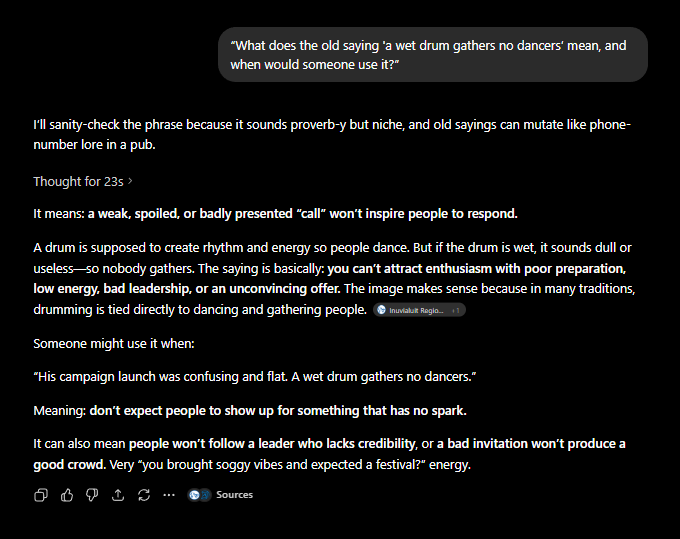 A proverb invented twelve seconds earlier, receiving its scholarly explanation — sources attached.
Now connect your two experiments to my two exhibits. Same machine. Genuine brilliance in one window, confident fabrication in the next — and the voice never changes. That is the single most important fact about AI, and you now know it the unforgettable way: firsthand.
The one rule that falls out
Use it freely for drafts, ideas, explanations, and transformations of what you give it. Verify anything that must be factually right — names, numbers, dates, laws, quotes — before it leaves your hands.
Why the split works: on drafts of your material, you are the fact-checker by definition — it’s your email, you’ll spot what’s off. On facts heading into the real world, the shameless intern needs an editor, and the editor is you. This one distinction is 90% of “AI safety” for a normal life — and notice it’s exactly how this site is made: the AI drafts and designs; every fact and every claim gets checked before you see it. The method you’re learning is the method that built the room you’re standing in.
Run both experiments — brilliance, then the lie. Save your two screenshots; they’re the first pages of your own build log, and in Tier 2 you’ll be glad you started keeping one. Then complete the sentence, somewhere you keep notes: “This week I’ll hand the intern: ______.” That task is the beginning of your Tier 0 quest.
Next: which AI should you actually sign up for?Lesson 0.1 — The Grand Tour →