
Lesson 1.4 · Tier 1 — Prompting
Thinking vs producing prompts is the distinction that quietly decides whether AI makes you faster or just busier. Every prompt you send is one of two species. A producing prompt asks for a deliverable: write this, build this, generate this. A thinking prompt asks for clarity: map my options, find the flaw, ask me what I haven’t considered. Most people only ever send the first kind — and then wonder why they keep receiving confident, polished versions of half-baked ideas.
This lesson teaches you to run the two modes deliberately and in the right order. Then the receipt: the single most consequential session in this site’s build log — the one that produced zero deliverables and designed almost everything you’re looking at.
Thinking vs producing prompts: know which room you’re in
Producing mode is what you learned in Lesson 1.0: tight specs, all four bones, narrow target. It rewards precision. Use it when you already know what you want and can describe the container.
Thinking mode is the opposite discipline: deliberately loose, no deliverable requested, breadth over polish. Its prompts sound like: “Map my options here, with the trade-offs of each.” “What am I not seeing?” “Argue the fork in the road for me — don’t pick, just sharpen both sides.” The output isn’t a thing; it’s a decision you couldn’t have made as well an hour earlier.
Mixing the modes ruins both, in both directions. Send a producing prompt while you’re still unsure what you want, and the machine will manufacture certainty you haven’t earned — a beautiful deliverable built on an undecided foundation, which you’ll redo. Send an over-specified prompt into a brainstorm, and you’ve fenced off exactly the territory you needed explored. The sequence is the skill: think first, decide as a human, then produce. And notice the connection to Lesson 1.0 — the thinking session is where the context bone of your future producing prompts gets manufactured. You’re not skipping work; you’re making the later work land on the first try.
From the build log: the session that produced nothing — and built everything
Before a single page of this site existed, the marathon conversation you met in Lesson 1.3 opened in pure thinking mode — a whole session with no deliverable requested anywhere. Its first message was a raw noun, not a request — “I want to talk about: CREATOR — as in, everything that can be built with AI” — and because nothing was asked to be produced, the machine did the thinking-mode job instead: it mapped the whole territory. Three spectrums came back — software & apps, media & content, business — each with its audience and its economics, plus a diagnosis of the empty slot: the category existed, the tools existed, but no single brand was the destination yet. If those three spectrums sound familiar, look at this site’s navigation. The three tracks of The Path are that answer, unchanged:
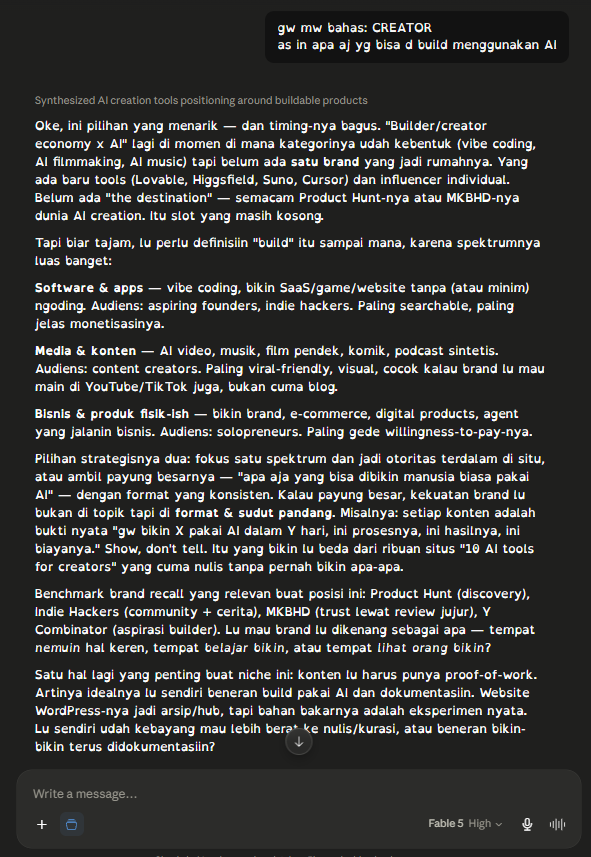
From the build log: a thinking prompt in its purest form — a raw topic, no deliverable requested — and the territory map that came back. The three spectrums in this reply became the three tracks of this site’s learning path, unchanged.
Then came the fork. The author answered the map with ambition: all of it — a brand so top-of-mind that “AI” triggers his name the way gamma radiation triggers Bruce Banner’s. And because this was still thinking mode, the machine did what thinking mode is for: it took the author’s own analogy and pushed back with it. Bruce Banner isn’t called because he’s an expert in all science — he’s called because he is the guy for gamma radiation:
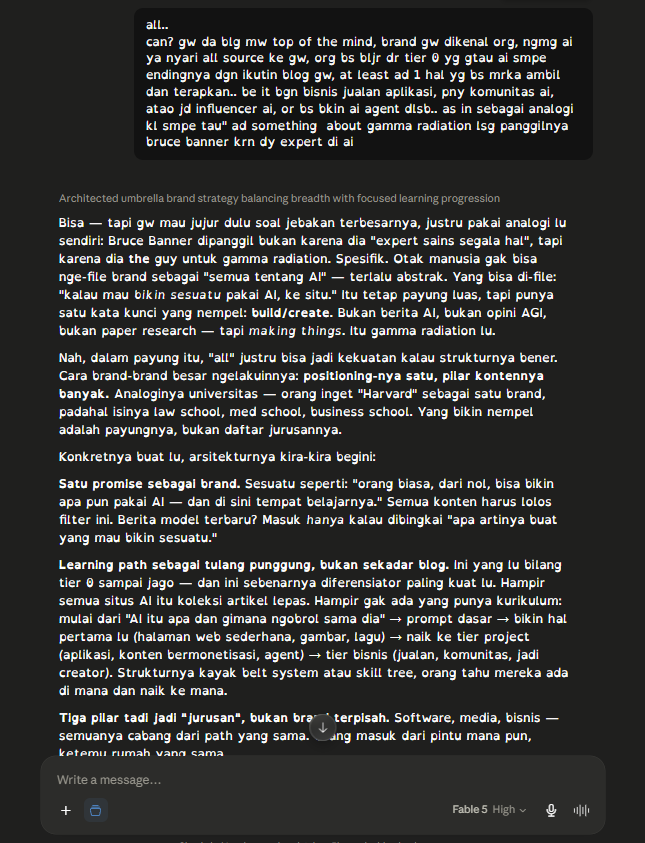
From the build log: the author’s “all of it” ambition, and the pushback built from his own metaphor — “Bruce Banner isn’t called for all of science; he’s the guy for gamma radiation.” A thinking session earning its keep by sharpening the fork instead of flattering the plan.
Count what this “unproductive” session created: the three-track architecture, the show-don’t-tell editorial DNA that later hardened into folklore with receipts, and a scope decision that had been stress-tested before it cost anything. Not one word of it was publishable. All of it is load-bearing. That’s the trade thinking mode offers you: an hour of producing nothing, in exchange for months of producing the right things. The most expensive prompts in your history won’t be the ones that failed — they’ll be the polished deliverables you built before you knew what you wanted.
Take the next real task on your plate — but forbid yourself the producing prompt. Send this first: “Don’t write anything yet. Map my options here with the trade-offs of each, then ask me the three questions I haven’t considered.” Decide as a human. Only then produce. That opener is entry #5 of your prompt library — the one that saves you from your own premature certainty.
Next: the intern learns to see, speak, and paint — a field guide beyond text.Lesson 1.5 — Beyond Text →