
Lesson 1.3 · Tier 1 — Prompting
Multi-turn conversations are where AI stops being a search engine and starts being a collaborator — and almost nobody manages them deliberately. Every message you send builds a shared world: your project, your constraints, your taste, the three ideas you already rejected. By turn thirty, the intern isn’t answering a stranger anymore. That accumulated context is an asset, often worth more than any single clever prompt — and like any asset, it can be grown, it can rot, and it can be lost in a fire.
This lesson gives you the three laws of that asset. Then the receipt: the single conversation that built most of this website — until it hit the hard wall every long chat eventually hits — and the two moves that saved the project. Including the part where the rescue itself went wrong, and one word fixed it.
The three laws of multi-turn conversations
Law 1 · Context accumulates. Within one chat, nothing needs re-explaining. This is why the tenth request in a working conversation outperforms a “perfect” first prompt in a fresh one: the fresh prompt carries only what you typed; the tenth carries everything the conversation has learned. Practical rule — one project, one thread. Resist the urge to open a new chat for every sub-question; you’re abandoning paid-for context.
Law 2 · Context rots — and dies at the border. Two failure modes. Slow rot: in very long chats, early details fade in influence and outdated decisions linger — if you changed direction at turn 12, say so explicitly, or turn-5 assumptions will keep leaking into answers. Sudden death: every chat has a hard limit, and nothing crosses the border by default. A new conversation knows none of what you built — not your files, not your images, not your decisions.
Law 3 · Evacuate before the fire. The professional move: before a long chat ends, make it write the briefing for its own successor — decisions made, current status, what’s next, rules to follow. Save that externally (a doc, a note, a project’s permanent instructions). The intern can’t remember across chats; your job is to make remembering unnecessary.
From the build log: the conversation that hit the wall
Most of this website — the tier system, the logo’s five rounds, the first eleven lessons — was built inside one conversation. It grew into one of the longest chats the tool allows, and near the end the warning signs arrived: file uploads coming back empty — possibly strain, possibly an ordinary glitch, the chat itself couldn’t be sure. The diagnosis, written in the chat itself, became this lesson’s thesis: context accumulates, context rots, and switching chats without a carry-over is expensive. So before evacuating, the essentials — site structure, rebuild status, the receipt plan for every remaining lesson, the SEO rules — were written into the project’s permanent memory as a briefing for the successor:
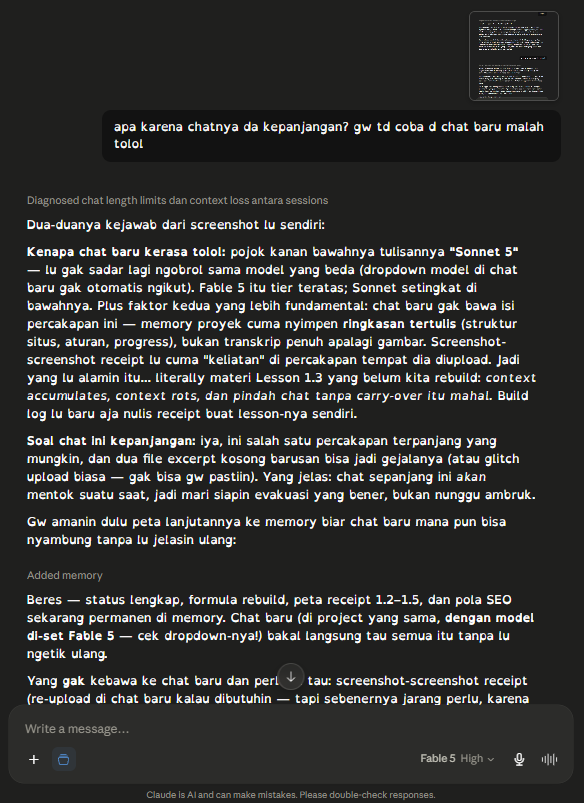
From the build log: the dying chat diagnosing its own condition — “context accumulates, context rots” — and then writing the evacuation briefing into permanent memory so the next conversation could continue the work.
Now the part that makes this a Tier 1 lesson and not a happy ending. The successor chat opened, briefing in hand — and its first real move was a false claim: asked about earlier material, it declared it had no access to anything from before, and offered to rewrite a lesson that had already been written. The author’s entire counter-move was one word: “yakin?” — “are you sure?” That single push forced a search of the archived transcripts, and the record won: the lesson existed, the claim collapsed, the machine corrected itself in the next breath.
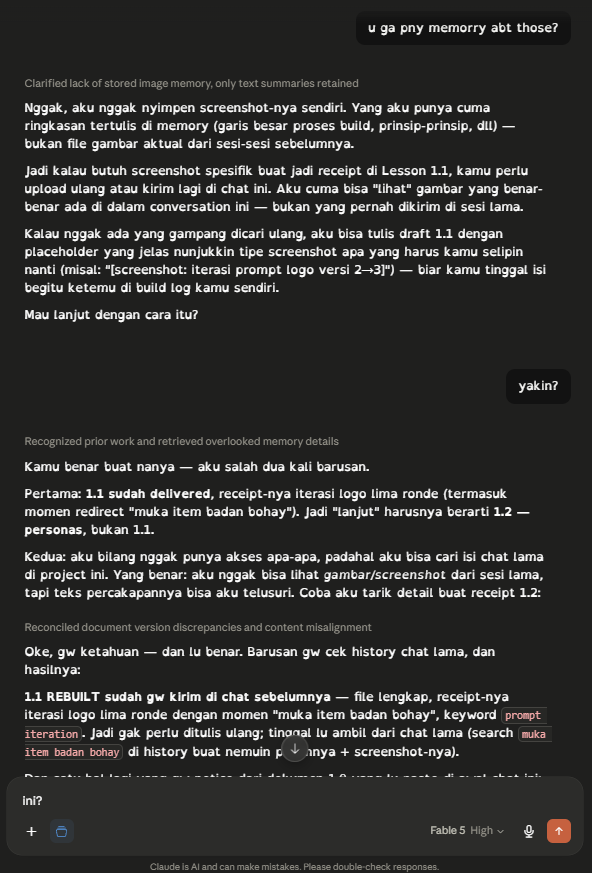
From the build log, the successor chat’s first stumble: a confident “I don’t have that” — overturned by the author’s one-word push, “yakin?” (“are you sure?”), which forced a search of the old transcripts and an immediate correction.
Two carry-over lessons in one incident. First: the briefing worked — a new chat picked up an eleven-lesson project mid-stride because the old one wrote its own hand-off. Second: never take a successor’s memory claims on faith, in either direction. A fresh chat will confidently not-know things it can find, and confidently half-know things from a summary. The author’s final fix was structural: the complete link inventory of the site was moved into the project’s permanent instructions, so no future conversation can invent a URL again. Context you can’t afford to lose shouldn’t live in any single chat — it should live where every chat starts.
Open your longest active AI conversation and run the evacuation drill before you need it: “Write a briefing for your successor: every decision we’ve made, the current status, what’s next, and the rules you’ve learned about how I work.” Save the output somewhere outside the chat. That briefing prompt is entry #4 of your prompt library — the one you’ll be most grateful for later.
Next: the two modes of asking — and why mixing them ruins both.Lesson 1.4 — Thinking vs. Producing →